



When someone on your team asks in Slack: "Should this setting go in advanced options or main preferences?" The thread fills up with opinions. "Advanced is cleaner." "Main is more discoverable." "Let's keep the UI simple." Twenty minutes of debate.
Nobody mentions what customers actually said in last month's interviews.
The decision gets made based on who argues most convincingly. Customer perspective never enters the conversation. This happens in your sprint planning too. Features get prioritized by engineering effort, not customer impact. PRD reviews focus on technical feasibility before anyone asks if users will understand the workflow.
You have the research. You ran solid interviews last quarter. Synthesized the findings. Updated your roadmap. The research isn't the problem.
The problem is that customer perspective disappears in the moments you actually need it. When you're in that Slack thread making a quick call. When you're in sprint planning juggling five priorities. When someone raises a concern and you need to decide right now whether it matters.
User interviews give you data about what customers said last month. Customer empathy is different. It's the ability to think from your customer's perspective automatically, without needing to dig through research notes. It's predicting how they'll react to the decision you're making right now, in this conversation, with the information you have available.
Why Research Alone Doesn't Build Empathy
Look, user interviews are valuable. They surface real problems, validate assumptions you were nervous about, and give you something concrete to point to when stakeholders ask "but do users actually want this?"
The problem? Watching customer interviews doesn't automatically change how you think when you're not watching customer interviews.
Think about the rhythm of most teams. You talk to customers every few weeks, maybe every month if you're disciplined. Between those sessions, you're making dozens of small decisions. Most product choices don't happen during scheduled research. They happen in sprint planning when you're juggling five priorities and need to pick three. They happen in Slack threads at 4pm when someone asks "should we show this setting in advanced options or main preferences?" They happen in PRD reviews when you're trying to ship something next week and someone raises a concern about complexity.
Those moments, the ones where you actually need customer perspective, are exactly when it's hardest to access.
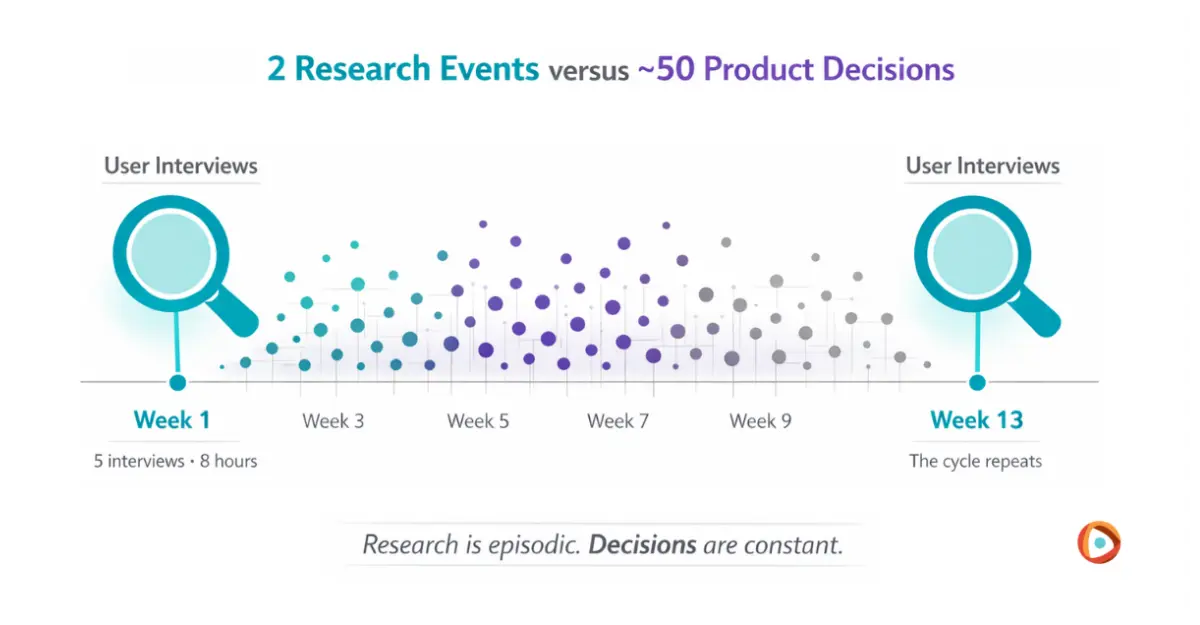
Sitting in on interviews doesn't automatically rewire your brain. You observe customer problems, take notes, maybe update a persona doc if you're being thorough. Then you close the document and return to building in your own mental framework. The insights stay trapped in a research folder instead of becoming reflexive.
Take a product team that ran excellent user interviews before every release. They did everything right. Synthesized themes, updated roadmaps, referenced insights in planning docs. Professional research process, genuinely good execution.
During sprint planning though, they still prioritized features by engineering effort, not customer impact. Someone would propose a feature and the conversation would immediately jump to story points and technical dependencies. The research informed what they built, but it didn't change how they thought about building. Customer perspective was something they checked occasionally, not something that guided their instincts.
Empathy is a muscle. It requires repetition. Doing five user interviews per quarter is like going to the gym twice a month and wondering why you're not getting stronger. Research gives you information. It doesn't give you the cognitive habit of defaulting to customer perspective when you're making rapid decisions under pressure.
What Customer Empathy Actually Means
Customer empathy gets confused with being nice to users. Or caring about their feelings. Or designing friendly interfaces with encouraging copy.
That's not it.
Customer empathy is a cognitive skill. It's the ability to accurately predict how customers will interpret and respond to your product decisions before you ship them. It means understanding their mental models well enough to anticipate their reactions. Recognizing their constraints before they tell you. Catching problems in the design phase instead of the support ticket phase.
You know a team has real customer empathy when you hear certain things in their conversations. During a feature discussion, someone says "Enterprise users will assume this works like their CRM because that's their mental model. If it doesn't, they'll think it's broken." During a PRD review, someone catches that your "simple" workflow actually requires six steps that users won't understand without training. During sprint planning, someone realizes a technically elegant solution requires users to learn new concepts they don't care about.
That's what good empathy sounds like. It's specific, predictive, grounded in how customers actually think.
Bad empathy is theater. It's saying "let's put users first" in a meeting without changing a single prioritization criterion. It's running interviews every quarter but never referencing those insights when you're making actual decisions. It's building exactly what users asked for without understanding why they asked, then being surprised when they don't use it.
Customer empathy means predicting customer reactions before they happen. Not gathering feedback after you ship and calling it validation.
The teams that build products customers love have strong empathy muscles. You can hear it. Customer perspective shows up in their daily conversations, not just during research phases. When someone proposes a solution, someone else instinctively pushes back: "Will users understand why they'd use this? What's their entry point? What happens if they don't know the feature exists?"
That reflexive customer-first thinking doesn't come from doing research quarterly. It comes from practicing customer perspective so often it becomes your default lens.
Three Ways to Build Customer Empathy Between Research Sessions
So how do you actually build empathy as a working skill? Here are three techniques that work. Not theoretical exercises. These are things teams actually do that change how they think.
1. Practice Scenario-Based Decision Making
Here's a simple one: give your team customer scenarios and ask them to predict behavior. Not "what do users want?" That's too abstract. Instead: "What would this specific user do? What would confuse them? What would they expect?"
Pull real customer profiles from past research. Present a specific situation. "Sarah, a marketing manager with three direct reports, just signed up for a trial. She needs to invite her team. What does she expect to happen when she clicks 'Add Team Member'?"
Have team members write their predictions individually. No discussing yet. Just write down what you think Sarah expects, what might confuse her, where she might get stuck.
Then compare answers.
This is where it gets interesting. You'll see completely different predictions. One person assumes Sarah expects email invitations. Another assumes she expects to copy a link. Someone else thinks she'll look for a "Share" button because that's what every other SaaS tool calls it.
Discuss whose predictions matched actual customer behavior (if you have data from support tickets or recordings). Or at minimum, discuss which predictions seem most plausible based on past research patterns.
The value isn't getting the "right" answer. It's training your team to inhabit customer perspective under specific conditions instead of defaulting to "well, I would just figure it out." You're not asking what users want in the abstract. You're asking what this specific user with these specific constraints would expect in this specific moment.
Do this for 15 minutes during sprint planning or weekly team meetings. Pull scenarios from recent support tickets, onboarding sessions, or past user interviews. Make it a regular ritual, not a one-off exercise you do once and forget about.
2. Run Time-Boxed Customer Problem Challenges
This one adds pressure, which is the point.
Set a timer for 10-15 minutes. Present a real customer problem or scenario. Have team members quickly frame the problem and propose solutions from the customer's point of view. Not from the technically optimal angle. Not from the "what's easiest to build" angle. From the "what's actually happening in the customer's world" angle.
For example: "A customer says their team isn't using the feature you shipped last quarter. You have 10 minutes. What questions would you ask to understand why? What would you look for?"
The time pressure prevents overthinking. When you only have 10 minutes, you can't dive into technical implementation details. You can't map out an entire architecture. You're forced to think intuitively about customer behavior, which is closer to how you need to think during actual product decisions.
You're building the reflex of asking customer-focused questions first.
You can use tools like Solution Showdown to structure this as a regular exercise. It adds AI evaluation and peer voting so you get feedback on whether your customer reasoning was sound. Turns it into more of a game than homework, which helps with the "practice weekly" problem most teams have.
The key is repetition. Weekly or biweekly practice builds habits faster than quarterly research sessions. The time constraint mimics real product work where you need to make quick calls without the luxury of extensive research.
Run this as a 10-15 minute team exercise weekly or biweekly. Rotate who brings the customer scenario so everyone gets practice pulling from support tickets or past research. After a few weeks, track whether your team's initial instincts in regular meetings start sounding more customer-focused.
3. Rotate Support and Onboarding Duty
This one's uncomfortable, which is why it works.
Have PMs and engineers spend 2-4 hours per month handling support tickets or watching onboarding sessions live. The rule: you can't escalate or delegate. You have to solve the customer's problem yourself using your product exactly as they experience it.
No back-end database fixes. No "let me update that for you" shortcuts. No explanations of how it's supposed to work. You guide them through the product as it exists today.
There's a story about a senior engineer who designed an "intuitive" settings migration workflow that had tested well internally. Then he sat with a customer trying to use it for the first time. The customer clicked "Import Settings," saw a modal with three options, paused for about ten seconds, then asked "Which one do I want?"
The engineer started to explain the difference between the three import methods. Halfway through his explanation, he stopped. You could see it on his face. He realized he was explaining something that should have been obvious. The customer shouldn't need to ask. The labels made perfect sense to someone who understood the technical architecture. They meant nothing to someone who just wanted to move their settings from the old system to the new one.
The engineer redesigned the flow the following week. Not because someone filed a bug report or because user research flagged it as a problem. Because he felt the friction himself.
This isn't research. It's direct exposure. After three support sessions where users get confused by the same workflow, you don't need a research report to know it needs fixing. You've experienced it. It's in your muscle memory now.
Schedule 2-4 hours per month per team member. Rotate people through support or live onboarding sessions. Debrief afterward as a team. What surprised you? Where did users struggle? What assumptions did we make that weren't true? You'll be surprised how much comes up.
Next Steps
Customer empathy isn't something you build once and check off a list. It's a skill that degrades without practice. Think about language learning. You can take an intensive Spanish course and come out conversational. Six months later, if you haven't been using it, you're struggling to remember basic vocabulary. Empathy works the same way.
Teams with strong empathy muscles practice regularly. You can hear it in their conversations. They reference specific customers by name: "This reminds me of what Jessica told us about her workflow. She'd definitely get confused by this." They challenge technically elegant solutions: "This makes sense to us, but users will expect it to work like X because that's the pattern every other tool uses." They predict reactions before building: "If we ship this without onboarding, 80% of users won't know it exists."
You'll know it's working when product discussions start with customer impact instead of ending with it. When someone proposes a feature and the first response is "which customer problem does this solve and how will they discover it?" instead of "how long will this take to build?"
Start with one technique from this post. Just one. Practice it weekly for a month. Track whether your team's conversations start sounding different.
The goal isn't running more research. You probably have enough research insights already sitting in documents nobody reads. The goal is internalizing what you already know by practicing customer-focused thinking until it becomes reflexive. User interviews give you data about what customers said last month. Customer empathy gives you the ability to think from their perspective automatically, even when they're not in the room, even when you're under pressure, even when the technically elegant solution is right there tempting you.
That's the difference.


