


If you ask someone about their dogfooding program, the first answer is usually the polite one.
"Yeah, we ship pre-release builds to a group of employees. They use the product, give us feedback, we make improvements before launch. It works, mostly."
That's the version that goes in the deck. It's the version everyone has agreed to call their dogfooding program. And in theory it's fine: a structured way for the company to test its own product before customers see it.
The second answer, the honest one, comes a few minutes later. Participation drops off after the first week. The same handful of people respond to everything; the rest of the company forgets the program is running. The feedback that does come in is mostly bugs, not the kind of insight that would change a launch. People treat it as a second job and engagement slips. We're working on it.
That's the version every program manager knows. Most dogfooding programs are messy in this same way, and most of the people running them know it.
Here's why that happens.
How I Learned to Stop Trusting the Bug List
I started noticing this years ago, when I was new to running early testing on a streaming-box product at a large consumer electronics company. We'd ship 100 units to employees. Maybe a dozen would respond. We'd ship 200. Maybe 25 would respond. Engineering would ask me how it was going.
I didn't really know how to answer that. I was looking for anything that resembled a signal, something I could point to and say the project is going well or the product is being received this way. The only thing I had that was objective was the bug submissions, so that's what I'd give them: a list of bugs. But I didn't have real confidence in it. I didn't know if that list actually answered the question being asked. It didn't answer it for me.
So I started walking around. This was before remote work, so I'd find people at their cubicles and just ask. "You were sent one of the units. Can I ask why you haven't filed any feedback?" The answers were all variants of the same thing: it felt like a second job. They had their actual work. They had this side thing. Install the unit, learn it, find the test cases, file the feedback, fill out the survey. It was someone else's job, usually QA's, and they were being asked to do it on top of theirs.
That's when I started seeing the structural problem underneath.
The "second job" framing started to explain everything. Participants weren't lazy or unengaged. They were doing exactly what made sense given how the program was set up. They were being asked to do real work on top of their roles, with no clear sense of what their feedback would do or who would read it. When they didn't see anything change because of what they filed, they stopped filing.
The structural truth underneath it: most dogfooding programs exist because the product isn't ready for external testers, and the company can't take the leak risk of a real beta. Employees are the lowest-friction group available. Already under NDA. Already in the building. Already on the payroll. Shipping to them is the easiest way to clear the "we tested it" checkpoint without taking on real exposure.
The problem is that a program built for distribution-convenience produces participation-as-chore. The whole thing was designed to be tested, not to generate signal. So it produces neither.
The compound cost isn't lost feedback. It's resentment: toward the program, toward the people running it, eventually toward the product itself.
Where Dogfooding Actually Came From
The term has been around since the '80s, and the version most people remember traces back to companies that wanted to prove a new technology was worth adopting by adopting it themselves first. The point wasn't to find bugs. The point was deep adoption: using a product enough to genuinely understand it, believe in it, and be able to convince the rest of the world to use it too.
That origin matters because it's the opposite of how dogfooding usually runs today. The original intent was adoption. The modern default is bug collection. Somewhere along the way the practice got absorbed into the QA function. It became a way to extend manual testing using internal people who happen to be cheaper and more available than a real beta population.
When that happens, dogfooding stops being dogfooding. It becomes internal UAT with a friendlier name.
The Reframe: Dogfooding Is an Adoption Program, Not a Bug Hunt
Here's the opinion I'll defend in any room: the feedback is the least valuable thing a dogfooding program produces.
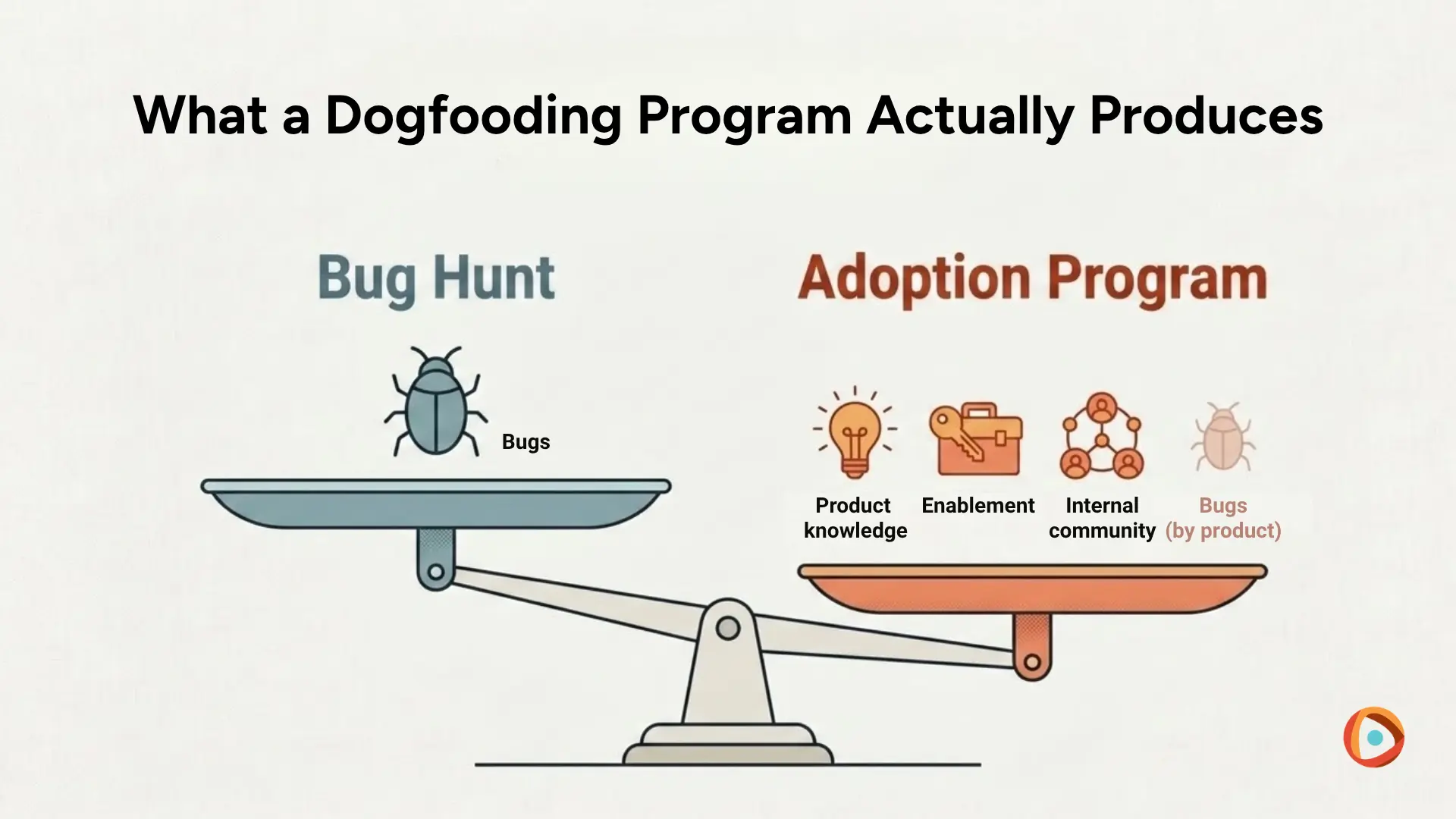
That sounds backwards. Feedback is supposedly the whole point. But think about where dogfooding feedback comes from. It comes from employees: people who are either positively biased because it's their company's product, or negatively biased because it didn't do the specific thing they wanted. Neither maps cleanly to how the market will actually respond. You can collect satisfaction scores, NPS, star ratings. And quietly, everyone running the program knows not to trust them, because they're coming from inside the building.
So if the feedback isn't the valuable part, what is?
Product knowledge. Enablement. Internal community. The benefits people don't usually associate with dogfooding are the ones worth running it for.
The companies that run dogfooding well aren't running a bug hunt. They're using the program to get their own people fluent in the product before it ships, treating employees as the product's first customers. A support person who has actually used the product knows how to support it before the first ticket comes in. A marketer who has lived with the product for a month knows how to position it without reading from a spec sheet. A regional sales lead who has used the thing knows how to change their strategy around what works and what doesn't. An executive who has actually completed the core use cases can talk about the product without sounding like they're reading a deck.
That knowledge, the application of having genuinely used the product, is what makes everyone downstream better at their job. The bugs you catch and the feedback you collect are real, and they matter. But they're byproducts. The real output of a working dogfooding program is a company that understands its own product the day before launch far better than it did the day before that.
I'll give you a concrete way to see the difference. Picture a company that makes connected fitness trackers. In a bug-hunt program, employees get a tracker, wear it for a few days, and file whatever breaks. In an adoption program, the company leans into what the product actually does. People compete on their step counts, compare sleep scores, try to beat each other's numbers. The product becomes part of how the company works and talks. The feedback that comes out of that is better, sure. But more importantly, the entire company now understands the product the way a customer would, because they've used it the way a customer would.
The same thing happens with physical products people genuinely engage with: cooking gear, smart home devices, anything where daily use creates real familiarity. Engagement isn't a problem you have to solve with incentives when people are actually using the thing for its purpose.
Software is harder, and worth being honest about. Not everyone at a company will run a beta test, or manage a project, or use a payroll system day to day. So "dogfooding" a B2B software product sometimes means stretching what testing means. But even then, the adoption logic holds. At Centercode, our own engineering and finance teams don't all run beta programs for a living, but participating in one helps them understand what our customers experience, which makes them better at building, supporting, and selling the thing. You don't have to be in a position to shape the product to gain from learning it. The learning itself is the product.
How to Tell Whether You're Really Dogfooding or Just Running QA With Employees
I can usually tell within two or three questions whether a company's dogfooding program is the real thing or theater. Here's what I listen for.
First, how the participants describe it. I asked someone at a large social-media company about their dogfooding once. The answer: "Every developer is required to run their own dogfooding to get feedback. It's kind of a pain." That told me everything. When the people inside the program describe it as a required chore, what you've built is a mandate. Mandates produce compliance, not fluency.
Second, whether they have any metrics. When I ask what they measure to know whether the program is working, and the answer is a blank, I know they haven't put real attention into it. No metrics usually means no process, which usually means it's being run ad hoc by whoever happened to inherit it.
Third, what they think of the data. The most common answer is "it's just not useful." A few people test it well and file good bugs; everything else is noise. That's the tell that the program was scoped as a bug hunt and is now producing exactly what a bug hunt produces: bugs, and not much else.
And underneath all three is usually the same operational reality: nothing is dedicated to managing the program. Feedback is scattered across Slack. People are expected to file in Jira. It feels like a QA test because, functionally, that's what it has become: an extension of manual testing using internal people.
None of that means the people running it are doing a bad job. It means the program was never designed for the thing dogfooding is actually good at.
Three Layers of Heat
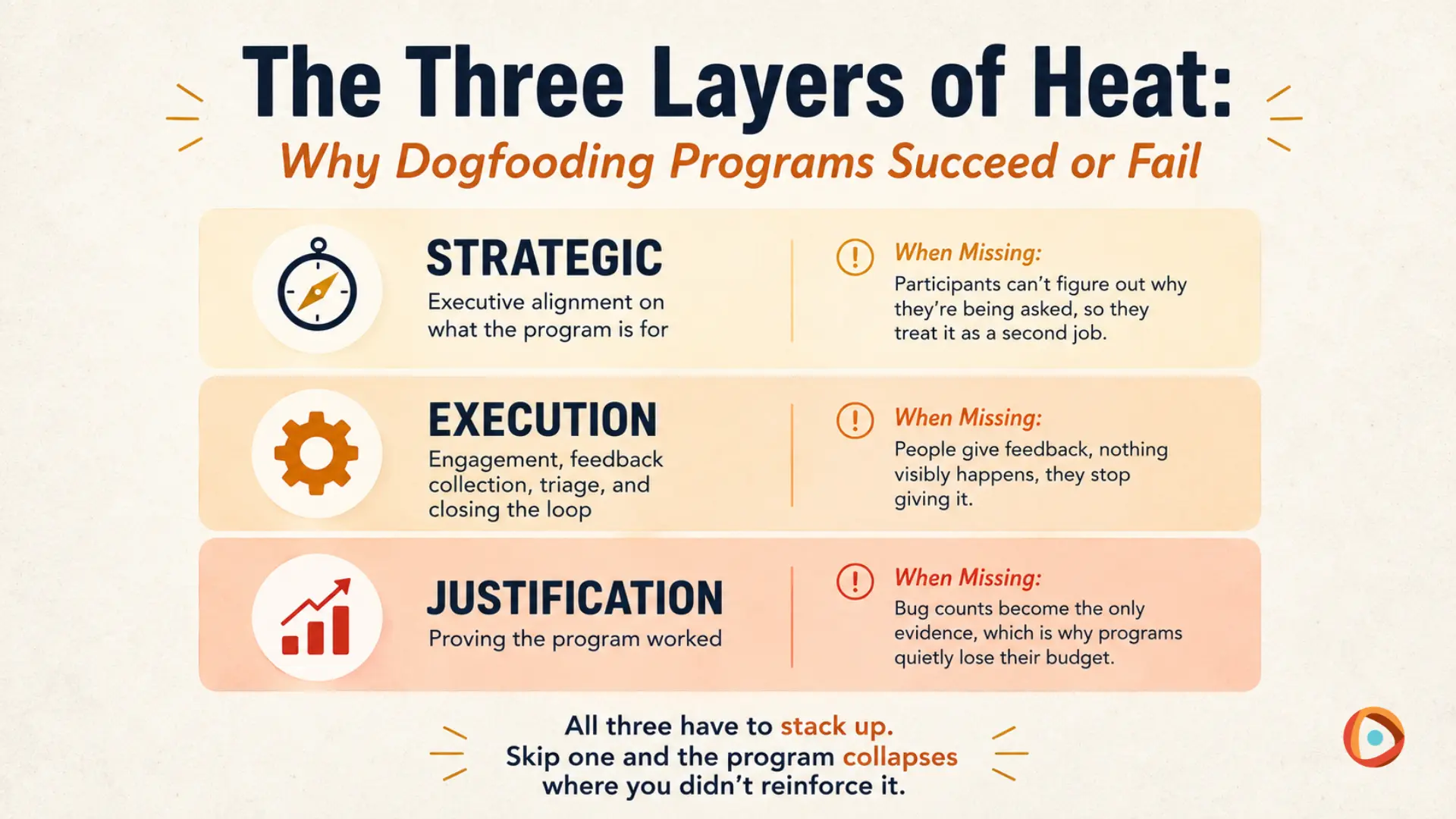
When I think about why dogfooding programs succeed or fail, it breaks into three layers. Each one generates its own kind of difficulty, and you have to clear all three.
The strategic layer. This is planning and executive alignment, the least interesting part and the most important. Before anything ships, the leadership team has to agree on what the program is for. Is it adoption? Is it product knowledge across support and marketing? Is it shaping the product? If the executive sponsors aren't aligned on the purpose, that misalignment trickles all the way down to the participant who can't figure out why they're being asked to do a second job. Most programs skip this layer because it's slow and unglamorous. It's also the layer that sets everything else in motion.
The execution layer. This is engagement, feedback collection, and triage. It's where most teams genuinely struggle, because acting on feedback is more work than collecting it. It's easy to gather input. It's hard to respond to it, route it, close the loop with the person who gave it. When that loop stays open, when people give feedback and nothing visibly happens, they stop giving it. The execution layer is where the resentment I mentioned earlier gets created or avoided.
The justification layer. This is proving the program worked. And here's the trap: if you've run a bug hunt, the only thing you can prove is bug counts. That's a weak justification, and it's why so many programs quietly lose their budget. If you've run an adoption program, you have something better to point to, but it's harder to present, which we'll get to.
All three layers have to stack up. A program with great execution but no strategic alignment produces orphaned effort. A program with strategic alignment but no justification loses its funding. You need all three.
The Operational Questions Every Program Runs Into
Once you've decided to run a real program, the same practical questions show up every time.
How do you recruit the right people? Recruiting is where most programs are quietly won or lost, and it's mostly about avoiding two failure modes. Recruit too narrowly (engineering only), and you get feedback from people who know the intended flows, know the workarounds, and have the deepest blind spots about how an actual customer will stumble. Recruit too broadly (the whole company), and feedback drowns in noise. The right roster is a deliberate mix, weighted toward the roles whose adoption you actually care about.
How do you collect feedback that's useful? The single biggest operational predictor of a good program is whether feedback has one low-friction intake point. Programs that route feedback through "just message me" channels lose most of the signal, not because people can't write the feedback, but because the social cost of repeating it through three different channels is too high. Give people one place to go that's easier than a Slack message, and you'll get more and better input.
How do you keep people engaged? Engagement is fundamentally a relevance problem. Prizes don't move it. People stay engaged when they're using the product for something they actually care about (the fitness-tracker effect) and when they can see their input mattering. The fastest way to kill engagement is to collect feedback and never respond to it.
How do you handle executive testers? This one deserves its own section, because it's the landmine almost nobody plans for.
The Executive Dogfooding Problem
Executives are, structurally, poor dogfooders. Not because they don't care. The friction is too high for the time they have. They rarely sit down and complete the core use cases. They rarely file feedback through the normal channel. But they have an enormous amount of sway, and they're often still dictating what the product should be and how it should work, without having done the actual testing that would ground that opinion.
That gap is where dogfooding programs implode.
I've watched it happen. The program runs quietly, nobody's getting much signal, and then an engineering executive pulls the program manager into their office and says, "Here's my feedback on the product. Take it to the team." Now you've got executive opinion entering the program through a side door, carrying more weight than anyone else's input, often without the use-case grounding that would make it reliable. The rest of the company senses it. They feel like the product is being pushed down their throats. They feel like their own feedback isn't going anywhere because the only feedback that moves the product is coming from the top. And they're still being held to the expectation of participating. That's the worst version of a dogfooding program: not the one that produces nothing, but the one that produces resentment while looking like it's running.
If you want executive participation to be useful, it needs different handling: more white-glove, lower-friction, with someone actually responsible for it. The honest problem is that this is hard to justify and rarely owned. It falls to a product manager, or to support, or to an exec's assistant, and it gets lumped in with everything else even though it needs a genuinely different approach. The teams that handle it well treat executive participation as its own track, with its own facilitation, rather than pretending an executive will use the same self-serve process as everyone else.
And sometimes the right move is to not put an executive into the general program at all. Give them a separate, facilitated way to engage so their input is grounded and their weight doesn't distort everyone else's.
What Adoption Looks Like, Role by Role
A real program changes how different teams work. Here's what that looks like in practice.
Marketing. A marketer who has used the product comes out of the program with strategy changes, not just talking points. They understand what the product actually does well, where the rough edges are, what to emphasize and what to avoid. They can build a launch around lived experience instead of a feature list.
Sales. Regional sales leaders who've used the product adjust their strategy around what works and what doesn't. They can speak to it with the authority of someone who's used it, and they can set customer expectations honestly because they know where the product is in its current state.
Support. Support teams that have used the product learn how to support it before the first ticket. They develop empathy for the user and an intuition for where customers will get stuck, which is most of the job.
Engineering. Engineers get the obvious benefits: finding bugs, stress-testing, covering gaps in test cases. But the bigger unlock in large organizations is cross-pollination. When engineering teams across different products in the same portfolio dogfood each other's work, they share solutions. "I solved this problem on our product. Let me show you how we did it." The product becomes the carrier for organizational knowledge transfer, and the whole portfolio gets more unified because of it. This is the part where dogfooding starts shaping company culture, not just the product.
Executives. When it works, an executive who's genuinely used the product can talk about it without reading from notes. That's worth more than most companies realize: the credibility of leadership talking about a product they actually understand.
How to Actually Measure a Dogfooding Program
This is the part most program managers get stuck on, because the honest answer is that the most valuable outcomes are qualitative.
If you lead your weekly status report with bug counts, you've already lost. You're justifying a bug hunt. The better report leads with the progression of knowledge and adoption across the teams you care about. That's harder to present, and it only works if you've aligned the executive level beforehand on the fact that this is what success looks like. Without that alignment, qualitative progress reads as soft data and gets dismissed.
What you can actually report:
- The behavioral signal. When people start talking about the product in their own team meetings, unprompted, in the course of their normal work, adoption is happening. That's the leading indicator, and it's observable.
- Before-and-after knowledge. Survey or interview participants at the start and end. How well do you understand this product? How would your team's strategy change given what you now know? The delta between those two answers is the closest thing to a hard metric you'll get, and it's genuinely useful.
- Testimony. Short interviews where participants describe, in their own words, how their product knowledge improved and how it changed their work. This is qualitative, but it's the most persuasive thing you can bring to an executive review.
- Efficiency signals, where you can get them. At a team or company level, is the work getting easier or faster because people understand the product better? Harder to isolate, but worth looking for.
The shift is from "how many bugs did we find" to "how much better does this company understand its own product than it did a month ago." The first is easy to count and means little. The second is hard to count and means everything.
The One Thing to Change Your Mind About
If you take one thing from this: stop thinking of dogfooding as a single-output activity that produces feedback.
It produces multiple things: product knowledge, enablement, internal community, and feedback and product improvements. The feedback is the part everyone fixates on, and it's the part with the most innate bias and the least reliability. The product knowledge and the community you build internally are harder to measure and far more valuable to your organization.
Think about what a company looks like when it's genuinely adopted its own product before launch. Support knows how to support it. Marketing knows how to position it. Sales knows how to sell it. Leadership can talk about it honestly. That company is in a fundamentally stronger position than one that merely caught a list of bugs. That's the program worth running. The bugs come along for the ride.
Getting Started
If you're standing up a program, or trying to fix one that's lost its way:
- Start with the strategic layer. Get the executive team aligned on what the program is for before you ship a single unit. If you can't answer "what's the purpose" in one sentence everyone agrees on, you're not ready to run it.
- Don't lead with bugs. Decide upfront what adoption success looks like and how you'll show it, so your justification layer isn't reduced to a bug count.
- Plan for the executive problem before you have one. Decide how executive participation will be handled (separately, facilitated, low-friction) so it doesn't enter through a side door and distort everything.
- Give feedback one low-friction home and close the loop. The fastest way to keep people engaged is to show them their input changed something.
Most companies don't have anyone whose actual job is to think deeply about their dogfooding program. The big technology companies that do dogfooding well, like Meta, Google, and Amazon, have dedicated people and executive sponsorship behind them. You may not have that. But you can run a program with the same intent: treat it as an adoption program, not a bug hunt, and you'll get more out of it than most companies ever do.
→ If you've outgrown what your team can run on its own, Centercode helps product teams run structured testing programs, from internal dogfooding through external beta, with the infrastructure to actually close the loop on feedback and measure what matters.


